Since late 2024, I’ve been regularly diving into the field of neuroscience, which I consider one of the most complex and fascinating domains of the human body.
My curiosity was sparked earlier through philosophy and psychology, so this isn’t my first encounter with the questions surrounding mind and behaviour. What neuroscience now offers me is the scientific foundation that underlies many of these ideas.
I still find it almost impossible to describe how fascinating it is that the firing of billions of neurons creates a coherent, functioning reality – one we can even observe from a meta-perspective.
Thinking about the depth and absurdity of human existence can be frightening, but it is also motivating. It shows where “you” – if there even is such a thing as a self – have leverage to change, to hack, to experiment with new ways of thinking and acting, and to reshape your own reality.
At the beginning of the year, I worked through the first 300 pages of my ~1000-page book, the German edition of Neuroscience: Exploring the Brain by Bear, Connors, and Paradiso. German is my native language, so I decided to use this version.
These first chapters cover the history of neuroscience as well as foundational topics including neurons and glial cells, the neuronal membrane at resting potential, action potentials, synaptic transmission, neurotransmitter systems, and the overall structure of the nervous system.
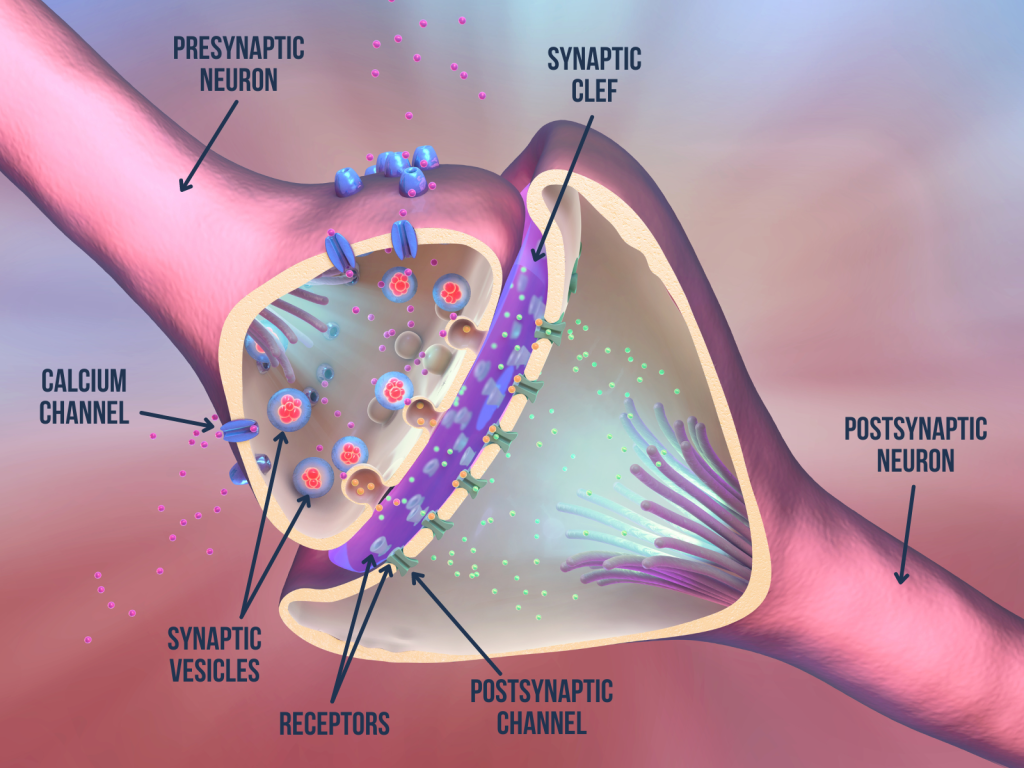
I was especially fascinated by synaptic transmission and will briefly describe how this process works, using two examples where substances such as cocaine or SSRIs (selective serotonin reuptake inhibitors) can disrupt its normal mechanism.
https://speechneurolab.ca/en/la-transmission-synaptique/
Neurons communicate through two main mechanisms:
(Inspired by a science-outreach post from Speech NeuroLab)
Key-Insight: The same synaptic mechanisms can underlie both addiction and medical intervention—depending on context, dosage, and control.
Working through these fundamentals gave me a solid foundation to understand how the brain operates at its most basic level. What fascinates me most is how small molecular events – like the release of a neurotransmitter – scale up into thoughts, actions, and even entire worldviews.
This first part was about the building blocks. In the next section, the focus will shift from single neurons and synapses toward larger systems and how they interact to create perception, movement, and ultimately behaviour.
https://speechneurolab.ca/en/la-transmission-synaptique/ https://nida.nih.gov/research-topics/cocaine#work